A Lasting Solution for a Complete Smile
Dental implants are a life-changing option for individuals who have lost one or more teeth. In contrast to alternative tooth replacement solutions, implants provide a sturdy, long-lasting base that closely resembles the structure of natural teeth, providing both practicality and visual appeal. North Hill Dental in Richmond Hill, Ontario uses premium materials and cutting-edge technology to guarantee that your dental implants fit perfectly with your natural teeth and give you back confidence and a completely functional smile.
Dental implants—usually titanium—are surgically inserted into the mandible to support a bridge or replacement tooth. Through a process known as osseointegration, the implant gradually bonds with the jawbone to form a sturdy base that resembles a real tooth root. Once the implant is firmly in position, an artificial tooth or crown is affixed to it to restore a natural tooth’s appearance, strength, and functionality.
To satisfy each patient’s specific demands, we provide a variety of dental implant options. Depending on the number of teeth being replaced and the condition of the jawbone, each type of implant has a distinct function.
Dental implants offer several advantages over traditional tooth replacement options, making them an ideal choice for long-term dental health and functionality.
Dental implants are nearly undetectable from the teeth around you because they are made to resemble natural teeth in both appearance and function. The crowns blend seamlessly with your smile, creating a natural, confident appearance.
Dental implants are an affordable investment that can last a lifetime with the right maintenance. Titanium implants fuse with the jawbone to form a solid foundation that won't move or loosen, making them incredibly strong and decay-resistant.
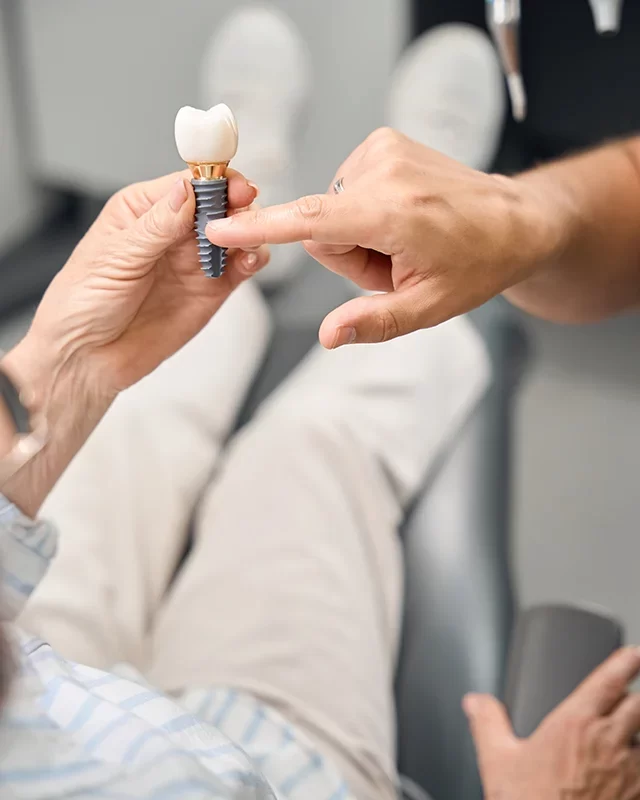

Like natural teeth, implants enable you to speak, chew, and bite with ease. Thanks to their stability, your everyday life will once again be comfortable and functional. You can eat a wide range of meals without worrying about discomfort or movement.

Dental implants boost your confidence in addition to enhancing the beauty of your smile. With dental implants, you can speak, laugh, and smile normally, knowing your teeth are secure, natural-looking, and beautiful.
Dental implants are a good option for the majority of healthy adults. The ideal candidates should have healthy gums, a dedication to maintaining proper oral hygiene, and enough jawbone density to support the implant.
You may be a candidate for dental implants if you:
In order to determine the status of your jawbone, our dental staff will undertake imaging, check your medical history, and evaluate your general health. With treatments like bone grafting or All-on-4 implants, which require less bone density, you can still be eligible for implants even if you have some bone loss.
The dental implant process involves several steps and may take a few months to complete, allowing time for healing and proper integration.
We start with a consultation to evaluate your oral health, discuss your goals, and select the best implant option for you. We use X-rays or 3D imaging to assess your bone structure and plan the implant placement.
During a minor surgical procedure, we insert the implant post into your jawbone. We use local anesthesia to ensure a comfortable experience. After placement, the implant site is left to heal for several months, allowing the implant and bone to fuse and create a stable foundation.
Once the implant has fully fused with the jawbone, we place an abutment—a small connector—on top of it. This serves as the attachment point for the replacement tooth.
In the final step, we place a custom-made crown onto the abutment. This crown is designed to match the shape and colour of your natural teeth, resulting in a beautiful and functional outcome.
Dental implants might be the best option for you if you’re ready to rebuild your smile with a long-lasting, realistic-looking treatment. We at North Hill Dental in Richmond Hill, Ontario strive to offer premium dental implants customized to meet every customer’s needs.
Call us to arrange your consultation and learn more about dental implants’ transformative advantages. With skilled treatment and cutting-edge technology, we can help you restore your smile, self-esteem, and quality of life.
Dental implants can last a lifetime with proper care. The implant post itself is designed to be permanent, while the crown may need replacement after 10-15 years due to normal wear.
The procedure is generally not painful, as local anesthesia is used to numb the area. Some mild discomfort or swelling may occur after surgery, but this typically subsides within a few days.
Caring for dental implants is similar to caring for natural teeth. Regular brushing, flossing, and routine dental check-ups are essential to maintain implant health and longevity.
Most adults with good oral health and sufficient jawbone density are candidates for dental implants. A consultation with our team will determine if any preparatory treatments, like bone grafting, are necessary.